Here’s something most people don’t know, and it sounds almost made up the first time you hear it: every single recognised school in India is run by a non-profit. Not most schools. All of them.
This isn’t a marketing line some school put on its website. It’s a hard rule. To get a CBSE affiliation under the Affiliation Bye-Laws — the 2018 version, updated again in 2025 — the school has to be owned by one of three things: a Society, a Trust, or a Section 8 company. All three have the same core feature by law: nobody can own them, and nobody can take profit out of them.
No shareholders. No dividends. No single owner who can quietly pocket whatever is left over at the end of the year.
And yet, look around you. There are families running their third school campus. There are SUVs parked outside in the principal’s reserved spot. There are private equity firms putting real money into school chains, the same way they’d invest in any other business. So here’s the obvious question: if the law says this entity cannot pay out profit, where is all that money actually going?
For a while, I assumed the simple answer: that this was quiet, common illegality. That everyone bends the rule a little and nobody really checks. That turned out to be a lazy answer. The real answer is more interesting, and more useful if you ever plan to run or invest in a school: most of this is completely legal, and the legality is the whole game. Let’s go through exactly how it works, piece by piece, because if you’re going to operate a school yourself, you will run into every single one of these.
Mechanism One: The Twin Structure
The most common setup is something I’ve started calling the twin structure, because that’s exactly what it is — two entities, built side by side, doing two different jobs.
- One is the non-profit Trust or Society. This is the legal entity that actually holds the school’s affiliation, its recognition, its name on the gate.
- The other is a plain, ordinary for-profit company — usually owned by the very same family that runs the trust.
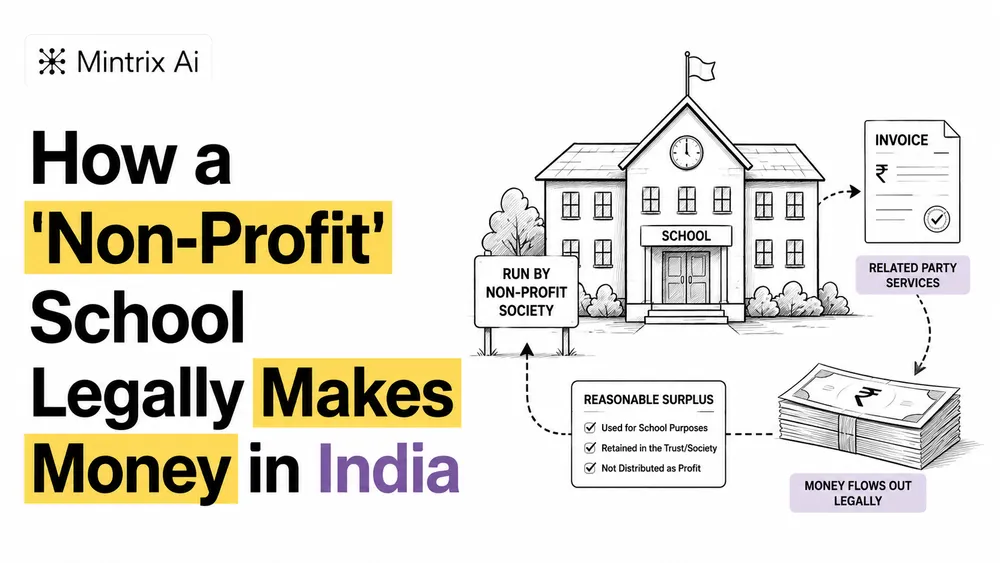
Here’s how the money moves between them. The for-profit company owns the land and the school building. It then rents that building out to the non-profit school, often on a long, multi-year lease.
The school pays rent every month or year. For the non-profit, that rent is just a normal running cost — it leaves the books cleanly, the same way paying for electricity or books would. But on the other side, that same rent lands in the for-profit company’s account as plain revenue. And because that company is a normal business, it’s completely free to pay that money out to its owners as profit.
The fee a parent pays doesn’t turn into a dividend directly. It first becomes rent. And rent is allowed to become a dividend.
This is not some clever trick that one school discovered last year and is quietly hiding. It is structural, common, and well known in the industry. To make it concrete: Birla Vidya Niketan in Delhi reportedly paid around ₹5.23 crore in rent through exactly this kind of arrangement. That’s not pocket change or a rounding error in an annual report. That is a deliberately built channel for moving money from a non-profit school into a for-profit company that shares the same founding family.
Mechanism Two: The “Reasonable Surplus”
Here’s a common misunderstanding worth clearing up: the non-profit rule does not mean a school has to end every year at exactly zero rupees of surplus. Courts have been quite clear on this — a school is allowed to keep what they call a “reasonable surplus,” and judgments have put rough numbers on what counts as reasonable, generally somewhere between six and fifteen percent.
This makes practical sense once you think about it. A school that can’t save even a little money can never build a new science block, can never survive one bad year of low admissions, and can’t even properly maintain its own buildings. So the law makes a sensible distinction: surplus is not the same thing as profit. Surplus is money that stays locked inside the institution and gets used for the institution.
So the legal line isn’t “you must end the year with zero rupees left.” The real legal line is simpler than that:
- A school that keeps twelve percent and puts it back into the school — new classrooms, better labs, teacher training — that’s completely fine.
- A school that takes that same twelve percent and quietly routes it out to a family-owned company, dressed up as inflated rent or a vague “consultancy fee” — that’s not fine at all.
In other words: the percentage you keep is allowed. It’s the destination of that money that decides whether you’re inside the law or outside it.
Mechanism Three: The Related-Party Invoice
This is the point where things tip over from “grey area” into “clearly wrong” — and it happens far more often than people assume.
A few common examples of how it plays out on the ground:
- The school buys all its bus and transport services from a company that happens to be owned by the trustee’s own son.
- It buys school uniforms from a supplier that turns out to be the chairman’s wife’s business.
- It pays a hefty “management consultancy fee” every year to a firm that, when you actually check who runs it, is the same founders again, just wearing a different hat.
On paper, each of these invoices looks completely ordinary — just another vendor bill. But stack enough of them together, and a pattern shows up. They’re really the school’s surplus quietly leaving through the back door, dressed up to look like a normal vendor payment.
And this is precisely the kind of thing that regulators do go after, sooner or later. The clearest real example anyone running a school in India should know is the Delhi case. The Anil Dev Singh Committee was set up to look into how Delhi’s private schools were using fee hikes, and after its review, it ordered 103 schools to refund roughly ₹104 crore back to parents — money the committee decided had been collected over and above what was actually justified.
Say that slowly: one hundred and three schools. One hundred and four crore rupees. That is not a small slap on the wrist. That is the system actively stepping in and enforcing the line between a fair surplus and outright extraction.
Why This Matters If You’re Building or Investing in a School
None of this is written to make school founders sound like villains. Running a school is genuinely difficult work, and it eats up a huge amount of capital. The people who do it well, and do it honestly, deserve to make a decent living from it. The real point here is narrower and more useful than blame:
The “non-profit” label on a school tells you almost nothing about whether that school is actually profitable. It only tells you how the money is legally allowed to travel.
What this means in practice, depending on who you are:
- If you’re an operator, the twin structure isn’t some shady shortcut — it’s simply the default way this entire sector is built. You should understand it clearly before you sign any lease for a school building, especially one where you are the tenant and somebody else owns the land underneath you.
- If you’re an investor looking seriously at a school chain, don’t stop at the trust’s profit-and-loss statement. By design, that document will look deliberately modest. The real numbers you need to look at are sitting in the for-profit company right next to it — the rent it’s charging, and the full list of vendors it’s billing the school for. That’s where the actual economics of the business live.
A school is allowed to keep a reasonable surplus. What it’s not allowed to do is run like a full-blown business while still calling itself a charity.
Nearly every public fight in this sector — fee-hike protests, refund orders from committees, even affiliation being cancelled — comes down to exactly this one question: where does the line between “fair surplus” and “extraction” actually sit? Once you can see the twin structure clearly, the SUV in the parking lot stops being a surprise. The far more useful question becomes: is this surplus actually building a science block — or is someone quietly using it to buy one for themselves?
FAQ
Why are Indian schools required to be non-profits?
CBSE affiliation under the Affiliation Bye-Laws (2018, amended 2025) requires the school to be owned by a Society, Trust, or Section 8 company — all non-proprietary, non-profit structures by law.
How do school owners make money if profit distribution is banned?
Most commonly through the “twin structure” — a separate for-profit company owned by the same family owns the school’s land and building, and charges the non-profit school rent. That rent becomes legitimate profit for the for-profit entity.
What is a “reasonable surplus” for a school?
Courts have generally allowed schools to retain a surplus in the range of 6–15%, as long as that surplus is reinvested into the institution rather than routed out to related parties.
What triggers regulatory action against a school’s finances?
Related-party transactions — paying inflated amounts to vendors owned by trustees or their families — are a common trigger. Delhi’s Anil Dev Singh Committee ordered 103 schools to refund roughly ₹104 crore collected through unjustified fee hikes
Leave a Reply