Category: school

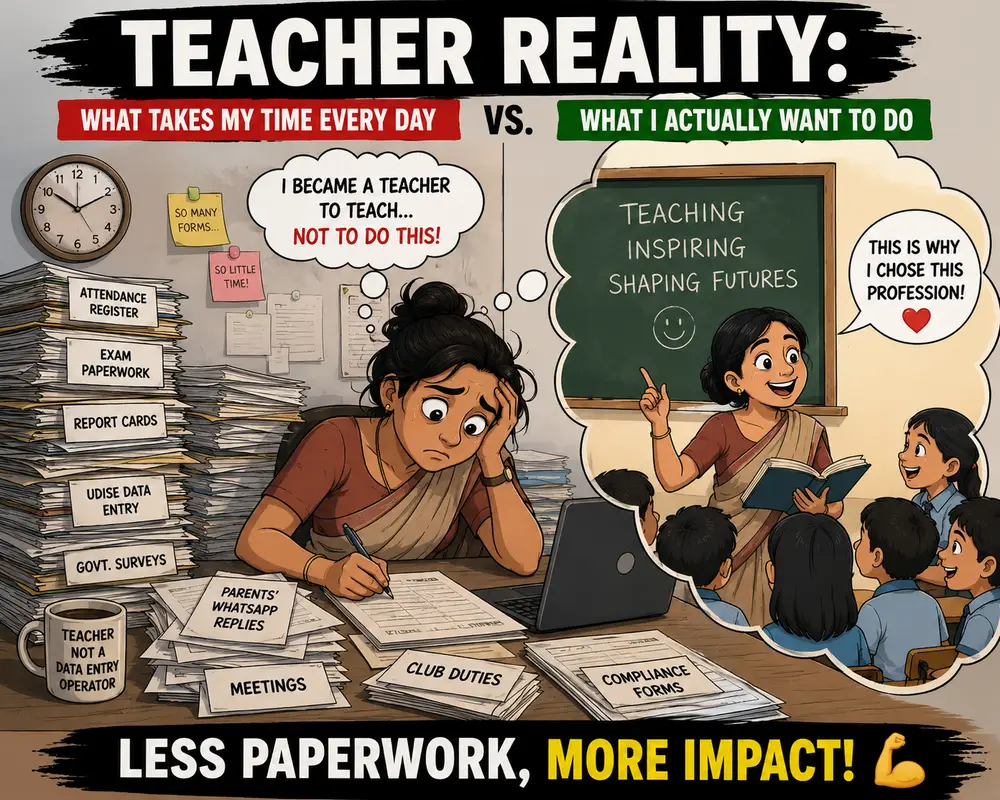
  • Serious question for teachers: Is paperwork becoming a bigger job than teaching?

    Serious question for teachers: Is paperwork becoming a bigger job than teaching?

    I always thought a teacher’s job was mostly… teaching.

    But the more teachers I talk to, the more I hear that teaching is only one part of the job.

    A lot of time seems to go into attendance, report cards, exam work, parent messages, UDISE updates, meetings, paperwork, and all the other admin work.

    So I wanted to ask the people who actually do this every day.

    For teachers (government, private, CBSE, ICSE, state board—any school):

    • About what percentage of your week is actually spent teaching and preparing lessons?
    • What’s the biggest non-teaching task that takes up your time?
    • Do you think the paperwork and admin work have increased over the last few years?
    • If you could get rid of one task tomorrow, what would it be?

    I’m asking because most people talk about AI helping students learn better.

    But I keep wondering if one of the biggest improvements would simply be giving teachers more time to teach and less time doing paperwork.

    Why Teachers Spend So Much Time on Paperwork

    Teachers didn’t sign up to be data clerks. But over the past decade, schools have added layer after layer of documentation. Every activity needs a record. Every student needs a report. Every parent expects an update.

    Some of it is useful. Most of it is repetition. A single teacher might type the same student data into three different systems in one week. That’s time she can’t spend helping a struggling reader.

    How Much of the Week Actually Goes to Teaching?

    The numbers are eye-opening.

    An EdWeek and Merrimack College survey found teachers work a median of 54 hours a week, but only 46% of in-school time is spent teaching. The OECD reports that teachers globally spend about half their working time on non-teaching work.

    Pew Research (2024) found that 84% of teachers say there aren’t enough hours in the workday to finish grading, planning, paperwork, and emails.

    So more than half the week goes to everything except teaching.

    The Tasks That Eat Up Most Time

    When teachers describe their week, the same items keep coming up:

    • Grading and feedback (around 5 hours a week)
    • Lesson planning and slide prep
    • Attendance registers and daily rollups
    • Parent messages, emails, and calls
    • Data entry into multiple portals
    • Circulars, permission letters, event forms
    • Meetings, both scheduled and surprise
    • Behaviour and discipline follow-ups
    • Non-teaching duties like corridor watch and bus loading

    One teacher summed it up bluntly online: “Data input, talking about data, worrying about data, gathering data, repeat.”

    What Teacher Burnout Really Looks Like

    Burnout isn’t just tiredness. It’s a slow drain that shows up as short tempers, missed sleep, and a shrinking love for the job.

    A 2024 TNTP report found that over 60% of teachers reported burnout, mostly because of workload. In India, a UNESCO survey showed that more than 60% of teachers list non-teaching duties as their biggest stress.

    Great teachers are leaving. Not because of students. Because of paperwork.

    Why the Admin Load Keeps Growing

    A few reasons stand out. Schools track more data than ever. Parents expect faster replies. Regulators want more compliance records. New tools get added, but old ones rarely leave.

    Each system was designed to help. Together, they became a maze. And teachers spend hours managing that maze instead of teaching.

    What Schools Should Automate First

    Not every task needs AI. Some just need better systems. Start here:

    1. Attendance capture and daily rollups
    2. Parent notification drafts
    3. Timetable adjustments and substitutions
    4. Progress report generation
    5. Fee reminders and permission slip tracking
    6. Lesson plan first drafts
    7. Meeting notes and follow-up emails

    If a task looks the same every week, it’s a strong candidate to automate.

    Can AI Actually Help Teachers?

    Yes — when used with judgment.

    A 2025 Gallup–Walton Family Foundation study found that teachers using AI weekly reclaimed an average of 5.9 hours per week. That’s nearly six weeks a year.

    AI can draft. AI can summarise. AI can sort data. It can turn a long parent complaint into a short note. It can generate a first version of a lesson plan. It can spot which students missed classes this month.

    That’s real time returned to real teachers.

    What AI Should Never Do

    There are lines AI should not cross:

    • Grading a personal essay without a teacher’s review
    • Deciding a student’s future or promotion
    • Sending a parent message without a teacher reading it first
    • Handling sensitive counselling or wellbeing notes

    AI is a strong assistant. It’s a poor judge. Teachers must stay in the driver’s seat for anything involving care, feedback, or trust.

    Practical Steps Schools Can Take This Week

    You don’t need a huge budget to start:

    • Audit repeated tasks. Ask teachers where the hour really goes.
    • Kill duplicate forms. One system, one entry.
    • Protect daily planning time.
    • Automate one workflow first. Attendance and parent messages are the easiest wins.
    • Review the impact after 30 days.

    Small wins build trust. Trust makes bigger changes possible.

    Where Mintrix Fits In

    Mintrix is an AI-native School Operating System. It was built to cut the repeat work that keeps teachers up at night.

    Attendance flows in on its own. Parent messages get first drafts. Lesson planning gets smart help. Reports come together in minutes, not weekends. Timetables adjust themselves when a teacher is absent.

    Mintrix doesn’t replace the teacher. It clears the desk so the teacher can teach.

    Conclusion

    Teachers joined this profession to spark curiosity, not to file forms. When schools take repetitive tasks off their plate, everyone wins. Students get more attention. Teachers get their evenings back. Schools see stronger results.

    The tools now exist to make this real. The only question is who will use them well.
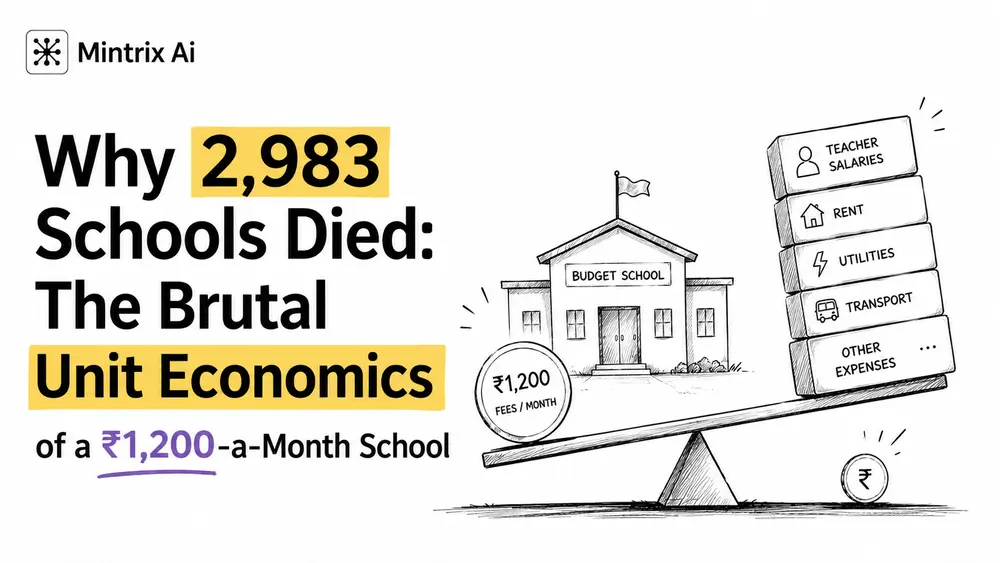
  • Why 2,983 Schools Died: The Brutal Unit Economics of a ₹1,200-a-Month School

    Why 2,983 Schools Died: The Brutal Unit Economics of a ₹1,200-a-Month School

    Here is a fact that reorganised how I think about Indian schooling:

    Around 70 percent of private-school students in India pay less than ₹1,000 a month in fees. Roughly 80 percent pay less than what the government itself spends per child.

    The image of “private school” as a marble-floored, air-conditioned thing is true for a thin top layer and false for the vast majority. The median private school in India is a budget school, and it survives on numbers that should not work.

    I wanted to feel those numbers, not just quote them. So I tried to build the rough P&L of a small budget school charging about ₹1,200 a month. I am not a school operator, so treat this as a learner’s model, not gospel — but even a rough model is clarifying, because it shows you where the whole thing is balanced on a knife edge.

    The Revenue Side Is Deceptively Simple

    Take a school with 500 students, which is already a decent-sized budget school. Fees of ₹1,200 a month, collected across the year, is about ₹14,400 per child annually. Five hundred children gives you roughly ₹72 lakh a year in fee revenue.

    That sounds like a lot until you remember it has to run an entire institution — building, staff, electricity, compliance — for a year.

    And that ₹72 lakh is the optimistic number, because it assumes everyone pays. They do not.

    Fee collection in budget schools is a genuine, grinding problem; a meaningful share of fees arrive late or never.

    So the real top line is lower than the headline, and the principal spends a startling amount of time chasing money from parents who are themselves stretched.

    The challenge goes deeper than just missed payments. How can a school reduce fee defaults and late payments? It starts with understanding cash flow patterns — when parents are most likely to pay, when they’re stretched, which segments are most reliable. It’s impossible to do this manually across 500 families. This is why fee management software for schools that automates reminders, tracks collection rates, and forecasts cash flow becomes critical infrastructure in this segment—not a nice-to-have, but a survival tool.

    The Cost Side Is Where It Gets Brutal

    The dominant cost in any school is people. Now here is the number that makes budget schools possible at all:

    Private-school teachers often start at around ₹15,000 to ₹21,500 a month.

    Compare that to a government teacher, who starts at around ₹42,600 and up.

    The entire budget-school model rests on paying teachers roughly a third to a half of the government rate.

    That is not a detail. That is the model.

    Let me put it on the table plainly, because it is uncomfortable and important:

    A budget private school delivers broadly similar core learning outcomes to a government school at about one-third of the cost — that is the finding from the Andhra Pradesh randomised trial published in the Quarterly Journal of Economics in 2015. The out-of-pocket cost to the family is far lower; the per-student spend is far lower.

    The biggest single reason the cost is one-third is that the teacher is paid a fraction.

    The affordability that parents love and the low pay that teachers resent are the same line item viewed from two sides.

    But there’s a hidden cost beneath the salary number. How does administrative workload affect teacher retention in budget schools? When a teacher earning ₹18,000 a month is also expected to manage attendance sheets, calculate grades by hand, respond to parent messages without a system, and track their own lesson progress—the job becomes unsustainable. The low salary would be grim enough; the administrative load makes it indefensible. This is why teacher turnover in budget schools is brutal, and new teachers must constantly be trained and integrated.

    Running the Numbers on a Real School

    So back to our 500-student school. Suppose you run a tight ratio and need around 25 to 30 teaching and support staff. At an average of, say, ₹18,000 a month, salaries alone run somewhere around ₹54 to ₹65 lakh a year.

    Against a realistic collected revenue that might be 60-odd lakh after leakage, you can see what has already happened: salaries can eat almost the entire top line before you have paid for anything else.

    And there is everything else:

    • Rent or building cost — Often the second-largest line item
    • Electricity — In a school with fans, lights, and computers, not small
    • Maintenance — Daily upkeep, repairs
    • Exam and affiliation fees — Non-negotiable compliance costs
    • Books and materials — Textbooks, classroom supplies
    • Transport — If you run buses, it’s its own little business with fuel and driver costs
    • Marketing during admission season — Essential for enrollment

    Each is modest; together they are the difference between a school that limps and a school that closes.

    How to reduce school operational expenses without lowering education quality? This is the question every budget school operator asks. The honest answer: you cannot cut salary costs further. You cannot cut building costs. But you can eliminate the waste in operations—the hours spent on manual entry, duplicate data, chasing down information that already exists somewhere in the school.

    This is where CBSE school management software that consolidates attendance, academics, admissions, and fee tracking into one system becomes a cost reducer—not just for efficiency, but for survival. Every hour a principal doesn’t spend chasing manual data or paper records is an hour they can spend on the real problems: teaching quality, student outcomes, and staff morale. A unified system with clear features for attendance, automatic fee reminders, and integrated reporting saves enough time to justify its cost—sometimes within the first few months.

    Why So Many Simply Die

    This is not abstract. In one year—2013-14—an estimated 2,983 budget schools shut down.

    Schools do not close because the founders lost interest. They close because the unit economics are this tight and one bad year pushes a structurally thin margin below zero:

    • A drop in admissions mid-year
    • A delayed fee cycle (parents pay late, school pays salaries on time)
    • A new compliance cost nobody budgeted for
    • A rent hike in an inflationary period

    Any one of these breaks a school that was already operating at the edge.

    There is also a cruel asymmetry baked in. To raise quality, you mostly have to raise teacher pay, because the teacher is the product. But raising teacher pay is the one move the model cannot absorb without raising fees, and raising fees breaks the affordability that is the school’s entire reason to exist.

    The budget school is trapped between a parent who cannot pay more and a teacher who cannot accept less. Most operators resolve that trap by squeezing the teacher, which is exactly why teacher-rights grievances cluster in this segment.

    What I Take From This Model

    Three things.

    First: The budget-school sector is not a low-margin business, it is a near-zero-margin public service that happens to be privately run — and we should stop being shocked that it cuts corners, and start being shocked that it functions at all on these numbers.

    Second: The lever everyone reaches for — “just improve quality” — runs straight into a salary line that has no give. You cannot raise quality without raising cost. You cannot raise cost without raising fees. You cannot raise fees without breaking your entire value proposition.

    Third: If you want to actually change anything here, the interesting questions are about cost structure: Can you cut the cost of the things that are not the teacher, so the teacher can be paid more without breaking the parent?

    That is the question I keep coming back to. I do not have the answer yet. But I am now certain it is the right question, because the P&L leaves room for nothing else.

    The Role of Intelligence in Budget School Operations

    This is where institutions of any scale face a critical inflection point. The budget school operator is doing the work of five people — chasing fees, tracking attendance, managing enrollment, handling compliance. How does a school intelligence platform improve institutional decision making?

    A true school intelligence platform doesn’t just collect data—it surfaces patterns that would be invisible in a spreadsheet. It shows you which students are at risk of dropping out before they’re gone. It flags which parents are most likely to default before the pattern compounds. It reveals which grades are over or under-staffed. It identifies which admission channels convert best, which teacher workflows are most efficient, which compliance deadlines are coming.

    Without this visibility, the principal is flying blind, reacting to crises. With it, they can anticipate problems, reallocate resources before they’re needed, and make trade-off decisions based on data instead of gut feel.

    This is not a luxury. It does not solve the salary constraint—only policy and market dynamics can do that. But it buys room. It cuts the chaos tax. It lets the principal spend time on the thing that actually matters: the teacher, and how to make that relationship work better.

    Mintrix Labs is where we share how we think about software, intelligence, and the institutions that have to live with both.

  • The Twin Structure: How Indian Schools Turn [No Profit] Into Real Profit

    The Twin Structure: How Indian Schools Turn [No Profit] Into Real Profit

    Here’s something most people don’t know, and it sounds almost made up the first time you hear it: every single recognised school in India is run by a non-profit. Not most schools. All of them.

    This isn’t a marketing line some school put on its website. It’s a hard rule. To get a CBSE affiliation under the Affiliation Bye-Laws — the 2018 version, updated again in 2025 — the school has to be owned by one of three things: a Society, a Trust, or a Section 8 company. All three have the same core feature by law: nobody can own them, and nobody can take profit out of them.

    No shareholders. No dividends. No single owner who can quietly pocket whatever is left over at the end of the year.

    And yet, look around you. There are families running their third school campus. There are SUVs parked outside in the principal’s reserved spot. There are private equity firms putting real money into school chains, the same way they’d invest in any other business. So here’s the obvious question: if the law says this entity cannot pay out profit, where is all that money actually going?

    For a while, I assumed the simple answer: that this was quiet, common illegality. That everyone bends the rule a little and nobody really checks. That turned out to be a lazy answer. The real answer is more interesting, and more useful if you ever plan to run or invest in a school: most of this is completely legal, and the legality is the whole game. Let’s go through exactly how it works, piece by piece, because if you’re going to operate a school yourself, you will run into every single one of these.

    Mechanism One: The Twin Structure

    The most common setup is something I’ve started calling the twin structure, because that’s exactly what it is — two entities, built side by side, doing two different jobs.

    • One is the non-profit Trust or Society. This is the legal entity that actually holds the school’s affiliation, its recognition, its name on the gate.
    • The other is a plain, ordinary for-profit company — usually owned by the very same family that runs the trust.

    Here’s how the money moves between them. The for-profit company owns the land and the school building. It then rents that building out to the non-profit school, often on a long, multi-year lease.

    The school pays rent every month or year. For the non-profit, that rent is just a normal running cost — it leaves the books cleanly, the same way paying for electricity or books would. But on the other side, that same rent lands in the for-profit company’s account as plain revenue. And because that company is a normal business, it’s completely free to pay that money out to its owners as profit.

    The fee a parent pays doesn’t turn into a dividend directly. It first becomes rent. And rent is allowed to become a dividend.

    This is not some clever trick that one school discovered last year and is quietly hiding. It is structural, common, and well known in the industry. To make it concrete: Birla Vidya Niketan in Delhi reportedly paid around ₹5.23 crore in rent through exactly this kind of arrangement. That’s not pocket change or a rounding error in an annual report. That is a deliberately built channel for moving money from a non-profit school into a for-profit company that shares the same founding family.

    Mechanism Two: The “Reasonable Surplus”

    Here’s a common misunderstanding worth clearing up: the non-profit rule does not mean a school has to end every year at exactly zero rupees of surplus. Courts have been quite clear on this — a school is allowed to keep what they call a “reasonable surplus,” and judgments have put rough numbers on what counts as reasonable, generally somewhere between six and fifteen percent.

    This makes practical sense once you think about it. A school that can’t save even a little money can never build a new science block, can never survive one bad year of low admissions, and can’t even properly maintain its own buildings. So the law makes a sensible distinction: surplus is not the same thing as profit. Surplus is money that stays locked inside the institution and gets used for the institution.

    So the legal line isn’t “you must end the year with zero rupees left.” The real legal line is simpler than that:

    • A school that keeps twelve percent and puts it back into the school — new classrooms, better labs, teacher training — that’s completely fine.
    • A school that takes that same twelve percent and quietly routes it out to a family-owned company, dressed up as inflated rent or a vague “consultancy fee” — that’s not fine at all.

    In other words: the percentage you keep is allowed. It’s the destination of that money that decides whether you’re inside the law or outside it.

    Mechanism Three: The Related-Party Invoice

    This is the point where things tip over from “grey area” into “clearly wrong” — and it happens far more often than people assume.

    A few common examples of how it plays out on the ground:

    • The school buys all its bus and transport services from a company that happens to be owned by the trustee’s own son.
    • It buys school uniforms from a supplier that turns out to be the chairman’s wife’s business.
    • It pays a hefty “management consultancy fee” every year to a firm that, when you actually check who runs it, is the same founders again, just wearing a different hat.

    On paper, each of these invoices looks completely ordinary — just another vendor bill. But stack enough of them together, and a pattern shows up. They’re really the school’s surplus quietly leaving through the back door, dressed up to look like a normal vendor payment.

    And this is precisely the kind of thing that regulators do go after, sooner or later. The clearest real example anyone running a school in India should know is the Delhi case. The Anil Dev Singh Committee was set up to look into how Delhi’s private schools were using fee hikes, and after its review, it ordered 103 schools to refund roughly ₹104 crore back to parents — money the committee decided had been collected over and above what was actually justified.

    Say that slowly: one hundred and three schools. One hundred and four crore rupees. That is not a small slap on the wrist. That is the system actively stepping in and enforcing the line between a fair surplus and outright extraction.

    Why This Matters If You’re Building or Investing in a School

    None of this is written to make school founders sound like villains. Running a school is genuinely difficult work, and it eats up a huge amount of capital. The people who do it well, and do it honestly, deserve to make a decent living from it. The real point here is narrower and more useful than blame:

    The “non-profit” label on a school tells you almost nothing about whether that school is actually profitable. It only tells you how the money is legally allowed to travel.

    What this means in practice, depending on who you are:

    • If you’re an operator, the twin structure isn’t some shady shortcut — it’s simply the default way this entire sector is built. You should understand it clearly before you sign any lease for a school building, especially one where you are the tenant and somebody else owns the land underneath you.
    • If you’re an investor looking seriously at a school chain, don’t stop at the trust’s profit-and-loss statement. By design, that document will look deliberately modest. The real numbers you need to look at are sitting in the for-profit company right next to it — the rent it’s charging, and the full list of vendors it’s billing the school for. That’s where the actual economics of the business live.

    A school is allowed to keep a reasonable surplus. What it’s not allowed to do is run like a full-blown business while still calling itself a charity.

    Nearly every public fight in this sector — fee-hike protests, refund orders from committees, even affiliation being cancelled — comes down to exactly this one question: where does the line between “fair surplus” and “extraction” actually sit? Once you can see the twin structure clearly, the SUV in the parking lot stops being a surprise. The far more useful question becomes: is this surplus actually building a science block — or is someone quietly using it to buy one for themselves?

    FAQ

    Why are Indian schools required to be non-profits?
    CBSE affiliation under the Affiliation Bye-Laws (2018, amended 2025) requires the school to be owned by a Society, Trust, or Section 8 company — all non-proprietary, non-profit structures by law.

    How do school owners make money if profit distribution is banned?
    Most commonly through the “twin structure” — a separate for-profit company owned by the same family owns the school’s land and building, and charges the non-profit school rent. That rent becomes legitimate profit for the for-profit entity.

    What is a “reasonable surplus” for a school?
    Courts have generally allowed schools to retain a surplus in the range of 6–15%, as long as that surplus is reinvested into the institution rather than routed out to related parties.

    What triggers regulatory action against a school’s finances?
    Related-party transactions — paying inflated amounts to vendors owned by trustees or their families — are a common trigger. Delhi’s Anil Dev Singh Committee ordered 103 schools to refund roughly ₹104 crore collected through unjustified fee hikes


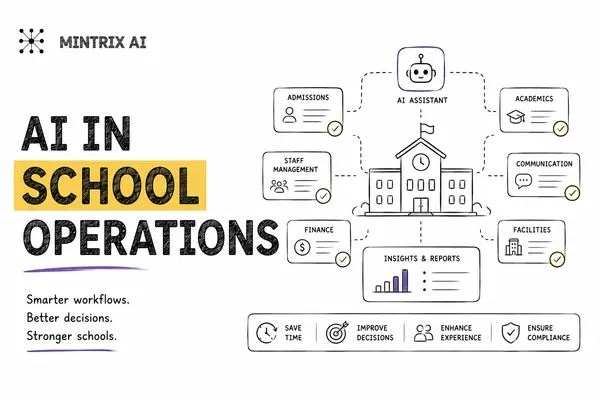
  • AI in School Operations: How AI Is Transforming the Way Schools Function

    AI in School Operations: How AI Is Transforming the Way Schools Function

    Artificial intelligence is no longer a future concept in education. While much of the public conversation focuses on AI in classrooms, one of the most powerful and immediate impacts is happening behind the scenes — in school operations.

    From attendance tracking and scheduling to parent communication and data-driven decision-making, AI is helping schools reduce administrative burden, improve accuracy, and create more responsive systems. For school leaders, administrators, operations managers, and IT teams, the question is no longer whether AI will influence school operations — but how to adopt it responsibly and effectively.

    This article explores how AI is transforming school operations, the measurable benefits, real-world use cases, potential risks, and a practical roadmap for implementation.

    Why School Operations Need AI Now

    Schools are complex organizations. A single campus manages hundreds or thousands of students, dozens of staff members, compliance requirements, parent communication, budgeting, facilities management, and academic tracking — often with limited administrative capacity.

    Research and policy guidance from organizations such as the U.S. Department of Education and the National Education Association emphasize that AI has strong potential to support administrative efficiency when implemented with proper governance, transparency, and human oversight.

    Several education-focused studies have also shown that automation and AI-supported workflows can significantly reduce time spent on repetitive administrative tasks. When administrative load decreases, school staff can redirect time toward student engagement, instructional improvement, and strategic planning.

    At the same time, surveys indicate that educators increasingly recognize AI’s operational potential, particularly in scheduling, reporting, and communication workflows. This shift in perception signals readiness — but readiness must be paired with strategy.

    What “AI in School Operations” Really Means

    AI in school operations does not mean replacing educators or automating leadership decisions. It refers to intelligent systems that:

    • Analyze large volumes of school data
    • Automate repetitive administrative workflows
    • Provide predictive insights for early intervention
    • Support decision-making with structured analytics
    • Improve communication responsiveness

    These systems may use machine learning, rule-based automation, natural language processing, or predictive modeling to assist human administrators.

    The goal is augmentation, not replacement.

    Core Use Cases of AI in School Operations

    1. Attendance Monitoring and Early Warning Systems

    Chronic absenteeism is one of the strongest predictors of academic decline. Traditional attendance systems often identify problems only after patterns are well established.

    AI can analyze historical attendance data, behavior records, and academic trends to detect early risk signals. Instead of manually reviewing spreadsheets, administrators receive structured alerts that highlight students who may need outreach.

    Benefits:

    • Faster identification of at-risk students
    • Targeted intervention strategies
    • Reduced manual reporting workload

    Human oversight remains critical. AI should flag concerns, but counselors and administrators must evaluate context before action.

    2. Intelligent Scheduling and Resource Allocation

    Scheduling is one of the most time-consuming operational tasks in schools. Balancing teacher availability, classroom capacity, student course selections, and compliance requirements creates complex logistical challenges.

    AI-driven scheduling tools can process thousands of constraints simultaneously, generating optimized timetables in a fraction of the time required manually.

    Operational advantages include:

    • Fewer scheduling conflicts
    • Better classroom utilization
    • Reduced manual adjustments
    • Faster schedule finalization

    Administrative teams retain final control, but AI significantly reduces initial workload.

    3. Automated Administrative Communication

    School offices handle large volumes of repetitive inquiries from parents, students, and staff. Questions about school hours, event dates, transportation, policies, or documentation requirements consume administrative capacity.

    AI-powered communication assistants can respond to frequently asked questions, route complex issues to the appropriate department, and provide instant responses outside office hours.

    Operational impact:

    • Reduced response time
    • Increased parent satisfaction
    • Less email overload for staff
    • Improved service consistency

    Transparency is essential. Automated systems should clearly indicate when a human follow-up will occur.

    4. Data Analytics for Leadership Decision-Making

    School leaders often rely on fragmented reports from multiple systems — attendance, academic performance, behavior records, and financial data.

    AI-powered analytics platforms can consolidate and analyze these datasets, identifying trends that may not be visible through manual review.

    Examples include:

    • Correlations between attendance and performance
    • Resource utilization patterns
    • Performance disparities across demographics
    • Predictive enrollment forecasting

    With better visibility, administrators can allocate resources more strategically and design targeted interventions.

    5. Grading Support and Workflow Automation

    While grading remains a professional responsibility, AI can assist with objective assessment scoring and structured feedback drafts. This reduces turnaround time for certain types of assignments and allows teachers to focus on higher-value instructional design.

    Best practice involves:

    • Using AI for first-pass grading
    • Maintaining teacher review for final evaluation
    • Avoiding AI-only scoring for high-stakes assessments

    AI should enhance consistency and efficiency — not replace professional judgment.

    Measurable Benefits of AI in School Operations

    When implemented correctly, AI in school operations can produce measurable improvements:

    • Reduced administrative hours per week
    • Faster response times for parent inquiries
    • Improved schedule accuracy
    • Early detection of attendance risks
    • Enhanced data-driven planning

    Education policy research consistently emphasizes that operational efficiency directly supports instructional quality. When administrators spend less time on repetitive processes, they can focus on strategy, teacher support, and student engagement.

    However, efficiency gains must be balanced with ethical safeguards.

    Risks and Responsible Implementation

    AI adoption without governance introduces risks. School leaders must address these proactively.

    1. Data Privacy and Security

    Schools handle sensitive student data. Any AI system must comply with student privacy laws and include strict access controls, encryption, and clear data retention policies.

    Leaders should:

    • Conduct data audits before implementation
    • Review vendor privacy policies
    • Ensure role-based data access
    • Communicate transparently with families

    Trust is foundational in education environments.

    2. Bias and Fairness

    Predictive models trained on historical data may reinforce existing inequalities. For example, attendance or discipline models may unintentionally reflect systemic bias.

    Mitigation strategies include:

    • Testing models on local data
    • Involving diverse stakeholders in evaluation
    • Maintaining human review of flagged cases
    • Monitoring fairness metrics regularly

    AI recommendations should always remain advisory, not determinative.

    3. Over-Reliance on Automation

    Automation can improve efficiency, but excessive dependence may reduce institutional awareness.

    Schools should:

    • Preserve human oversight
    • Conduct regular performance reviews of AI systems
    • Define escalation processes
    • Maintain manual backup workflows

    AI must support decision-making, not replace leadership judgment.

    4. Academic Integrity Concerns

    As AI tools become more common among students, schools must update policies around responsible use.

    Operational systems and academic policies should align. Leaders must ensure:

    • Clear academic integrity guidelines
    • AI literacy programs
    • Assessment redesign where appropriate

    Ignoring AI use among students creates policy gaps and confusion.

    A Strategic Roadmap for Implementation

    Successful AI adoption in school operations requires structured planning.

    Step 1: Define a Clear Operational Problem

    Start with a measurable goal, such as:

    • Reducing scheduling errors by 30%
    • Improving attendance intervention speed
    • Cutting administrative email response time

    Avoid broad or undefined transformation goals.

    Step 2: Assess Data Readiness

    AI systems depend on clean, structured data. Conduct an audit to evaluate:

    • Data consistency
    • System integration compatibility
    • Data ownership
    • Compliance requirements

    Poor data quality undermines AI performance.

    Step 3: Pilot Before Scaling

    Implement AI solutions in a limited scope first. Define key performance indicators and collect feedback from administrators, teachers, and parents.

    Measure:

    • Time saved
    • Error reduction
    • User satisfaction
    • Process improvements

    Only scale solutions that demonstrate measurable impact.

    Step 4: Train Staff and Update Policies

    Technology adoption fails without training. Provide:

    • Role-based staff workshops
    • Clear documentation
    • Updated acceptable-use policies
    • Communication plans for families

    Confidence drives adoption.

    Step 5: Establish Governance and Oversight

    Create a governance committee that includes:

    • School leadership
    • IT personnel
    • Teachers
    • Parent representatives

    Define review cycles and auditing procedures to ensure systems remain aligned with school values.

    Long-Term Impact of AI in School Operations

    Over time, AI can help schools become:

    • More proactive instead of reactive
    • Data-informed instead of assumption-driven
    • Efficient without sacrificing personalization
    • Transparent and accountable in operational decisions

    The greatest impact occurs when operational efficiency translates into instructional quality. Reduced administrative friction gives leaders more time to support teachers and students directly.

    However, success depends on disciplined implementation, ethical safeguards, and continuous evaluation.

    Conclusion

    AI in school operations is not about replacing educators or automating leadership. It is about intelligently redesigning workflows to reduce administrative burden, improve data clarity, and strengthen decision-making processes.

    Schools that approach AI strategically — with clear objectives, strong governance, privacy protections, and human oversight — can unlock measurable efficiency gains while maintaining trust and equity.

    The future of education will not be defined solely by classroom innovation. It will also be shaped by how effectively institutions manage operations behind the scenes.

    When implemented responsibly, AI becomes a strategic partner in building smarter, more responsive, and more efficient school systems.

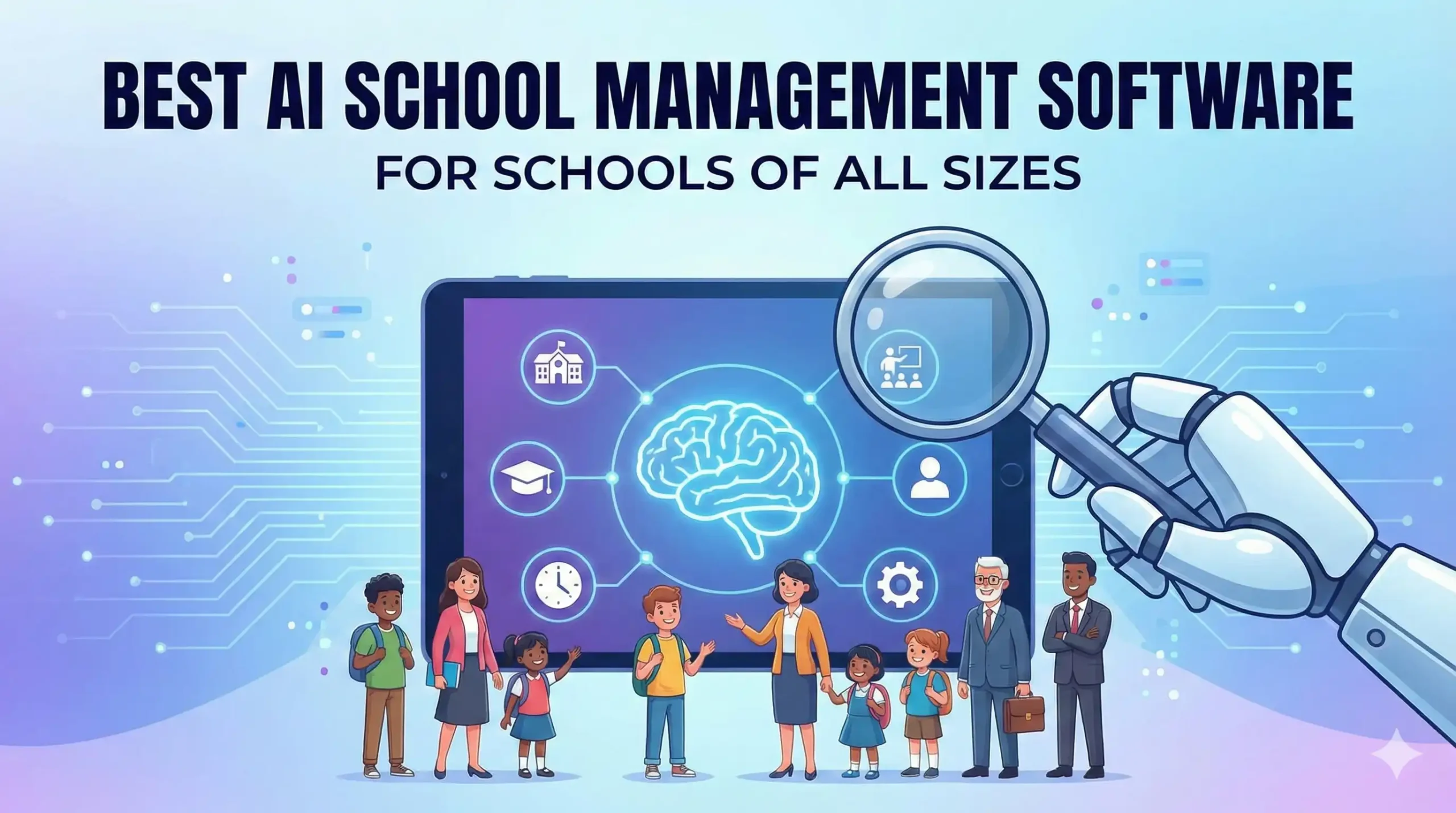
  • Best AI School Management Software for Schools of All Sizes

    Best AI School Management Software for Schools of All Sizes

    Introduction: A New Era for School Management

    In today’s fast-moving education landscape, school leaders are under more pressure than ever. From handling manual attendance and class planning to setting up timetables and managing fees — traditional systems are time-consuming and inefficient. Teachers lose valuable hours in repetitive tasks, and administrators struggle with outdated tools that don’t communicate with each other.

    This is where AI in education is making a transformational impact. With smart school management software powered by AI, schools can now streamline every process and make learning more effective, efficient, and engaging.

    The Real Pain Points in Schools

    • Manual Attendance: Teachers spend up to 20 minutes a day taking roll calls.
    • Classroom Planning: Daily lesson plans are repetitive and hard to track.
    • Timetable Setup: Creating and managing timetables manually is prone to conflicts.
    • Fee Management: Delays, manual errors, and lack of real-time tracking.
    • Parent Collaboration: Difficult communication, delayed updates, and inconsistent engagement.

    These problems reduce productivity and take focus away from what matters most: student learning.

    Introducing AI School Automation

    AI-powered EdTech tools now offer an integrated solution that combines everything under one platform. From automated reports and notifications to intelligent chatbots and predictive analytics, schools can now operate smoothly without micromanagement.

    Let’s take a closer look at the core benefits.

    Benefits of AI in Education

    1. Higher Productivity

    AI automation helps reduce manual work by 30-40%, allowing teachers and administrators to focus more on educational outcomes.

    2. Smart Decision Making

    AI for schools provides data-driven insights to help school leaders make informed decisions.

    3. Personalised Learning for Every Student

    With personalized learning AI, each student gets tailored content based on their strengths and weaknesses.

    4. 24/7 Support with Smart School Chatbots

    An AI chatbot acts as an always-on assistant for students, parents, and teachers, answering queries and sending reminders instantly.

    5. Efficient Administration

    From fee tracking to scheduling and report generation, AI takes care of day-to-day school operations with minimal human effort.

    Key Features to Look for in the Best AI School Management Software

    Automation for Admin Tasks

    • Auto-attendance
    • Digital timetable creation
    • Automated report cards
    • Real-time fee tracking

    Smart Chatbots

    • Answer student doubts
    • Send parent notifications
    • Schedule meetings automatically
    • Available 24/7

    Predictive Analytics

    • Identify students at risk of dropping out
    • Track academic progress
    • Suggest learning interventions

    Personalized Learning Paths

    • AI assesses student performance
    • Creates adaptive learning plans
    • Tracks individual learning outcomes


    Traditional Learning vs AI-Powered Smart Learning

    Feature Traditional Learning Smart Learning with AI
    Attendance Manual roll call Automated & accurate
    Lesson Planning Paper-based, repetitive AI-assisted, dynamic
    Timetable Excel or pen-paper Auto-generated, conflict-free
    Fee Management Manual entries Real-time tracking, reminders
    Parent Communication PTM calls or messages Instant chatbot alerts
    Student Support One-size-fits-all Personalized learning paths
    Admin Tasks Tedious, manual 30-40% time saved with automation

    Why Mintrix Stands Out (Without Saying Too Much)

    Many platforms offer pieces of the puzzle — a chatbot and a timetable app. But only a few provide a full-stack solution like Mintrix education technology, where everything works seamlessly under one ecosystem.

    • A single platform connecting teachers, students, parents, and admins
    • AI-based session planning, attendance, and reporting
    • A smart school chatbot that “knows everything” about the school
    • Real-time updates and complete school automation

    By using a system like this, schools can reduce daily manual tasks by up to 30%, boosting productivity and simplifying school operations.

    Use Cases for Schools of All Sizes

    Small Schools

    • Save time and money by reducing manual tasks.
    • Teachers get more time to focus on students.
    • Simple dashboards that are easy to learn and use.

    Medium Schools

    • Better communication with parents.
    • Track how students are doing in real time.
    • Automate everyday admin work like attendance and scheduling.

    Large Schools

    • Manage all campuses from one system.
    • Use AI to support smarter decisions.
    • Get a full view of teacher performance and student results.

    This makes AI school automation useful no matter the size of your school—small, medium, or large. Everyone benefits from better organisation, faster work, and smarter learning

  • How AI is Revolutionizing School Management: The Mintrix Approach

    How AI is Revolutionizing School Management: The Mintrix Approach

    In today’s fast-changing world, education is no longer limited to books and classrooms. With technology growing rapidly, schools in India and around the world are now adopting AI-powered EdTech to improve the way they operate and educate. Among the biggest changes we are seeing is the use of AI in education—especially in how schools are managed.

    Gone are the days of manual data entries, outdated ERP systems, and fragmented tools. AI is now making school operations smoother, smarter, and more effective than ever. Let’s look at how AI school automation is changing the game, and how a complete AI approach is giving schools a much-needed upgrade.

    The Problem with Traditional School Management

    Most schools still rely on outdated school management software or use multiple tools for different tasks—one for attendance, another for fees, and yet another for learning management. This results in confusion, duplication of efforts, and wasted time for teachers, administrators, and even parents.

    In many cases, teachers are spending more time on administrative work than on teaching. Parents often don’t get timely updates. Students feel disconnected. And school heads struggle to make decisions due to a lack of real-time data.

    This is where AI in education offers a better solution.

    The Rise of AI in School Management

    AI (Artificial Intelligence) is no longer a future concept. It’s already being used in banking, healthcare, and now, education. With AI, schools can automate most of their day-to-day tasks. From attendance to fee collection, homework to report cards—everything can be handled by smart systems.

    But it’s not just about doing things faster. AI adds intelligence. It learns from data and improves processes over time. It can alert teachers when a student is falling behind. It can remind parents about an upcoming PTM. It can predict dropouts based on behavioural trends.

    This is called AI school automation, and it’s changing how schools operate.

    Automating the Core: From Admin to Classroom

    With an AI-first platform, school management becomes much simpler. Here’s how AI is streamlining major areas:

    1. Teacher and Staff Management

    AI tools can handle scheduling, leave tracking, class substitutions, and performance monitoring. Teachers also get real-time suggestions for better lesson planning and classroom management. This allows them to focus more on teaching.

    Keyword Focus: AI for teachers, AI school automation

    2. Student Performance Tracking

    AI can analyse learning data and track how each student is doing. Based on that, it creates personalized learning AI paths, helping each student learn in a way that suits them best. This improves outcomes and boosts confidence.

    Keyword Focus: personalized learning AI, AI in education

    3. Smart Fee and Finance Automation

    No more missed fee payments or late records. AI automates reminders, tracks payments in real time, and even helps predict future cash flow. This helps schools stay financially healthy.

    Keyword Focus: school management software, AI-powered EdTech

    4. AI Chatbots for 24/7 Support

    Imagine having a school receptionist, helpdesk, and assistant all rolled into one—available anytime. That’s what a smart school chatbot does. Whether it’s a parent query, a teacher’s question, or a student’s doubt, the chatbot handles it instantly.

    Keyword Focus: smart school chatbot, AI in education

    Real-Time Communication with Parents

    Communication gaps between schools and parents are a common problem. AI solves this with real-time updates on attendance, grades, homework, and events. Parents stay informed without needing to call or visit the school repeatedly.

    AI also helps schedule parent-teacher meetings and even generates reports automatically. This not only saves time but improves parent engagement, which is key to a child’s success.

    Data-Driven Decisions for School Leaders

    A major advantage of AI in school management is data. From teacher performance to student behaviour, AI collects and presents data in a simple dashboard. School leaders can take quick, smart decisions based on this information.

    Want to know which teacher’s class shows better student engagement? Or which students need extra support? AI can tell you in seconds.

    Keyword Focus: AI-powered EdTech, Mintrix education technology

    Personalised Learning for Every Child

    Every student is unique. Some learn by reading, some by watching, and others by doing. AI can detect each student’s learning style and create custom paths accordingly. This is called personalized learning AI, and it’s helping students achieve better results.

    By tailoring content and pace, AI ensures that no child is left behind.

    An Ecosystem, Not Just a Tool

    The biggest strength of a true AI-first solution lies in its integration. Schools no longer need 10 different platforms. Everything is available in one AI-powered system—from academics to administration, from staff to students.

    When all modules talk to each other, efficiency increases, mistakes reduce, and users have a smooth experience. Teachers teach better, students learn better, and administrators can focus on growth.

    Why This Matters in the Indian Context

    India has one of the largest education systems in the world. Managing schools efficiently across cities, towns, and villages is not easy. Many schools face challenges like staff shortages, parent engagement issues, and limited access to technology.

    An AI-based approach bridges these gaps. It brings smart solutions even to remote schools. It supports teachers, empowers students, and gives school leaders complete control.

    Conclusion: The Future is Smart, Are You Ready?

    As the world moves towards automation and intelligence, schools cannot be left behind. With AI-powered EdTech, schools are no longer just digitised—they are transformed.

    AI in education is not about replacing humans. It’s about giving them superpowers. Teachers get more time, students get more support, and parents get more peace of mind.

    Whether you’re running a school in a metro city or a small town, it’s time to rethink how your school operates. The right AI school automation platform can make all the difference.

    If you’re looking for a smarter, easier, and more effective way to manage your school, now is the time to explore what’s possible with AI.

    👉 Want to see how AI can transform your school? [Book a Free Demo Today]