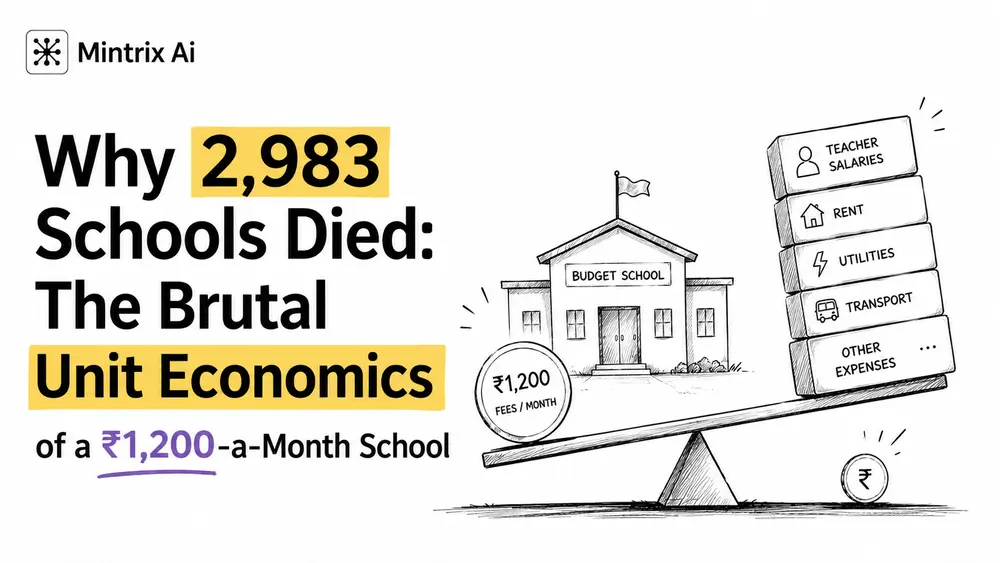
Here is a fact that reorganised how I think about Indian schooling:
Around 70 percent of private-school students in India pay less than ₹1,000 a month in fees. Roughly 80 percent pay less than what the government itself spends per child.
The image of “private school” as a marble-floored, air-conditioned thing is true for a thin top layer and false for the vast majority. The median private school in India is a budget school, and it survives on numbers that should not work.
I wanted to feel those numbers, not just quote them. So I tried to build the rough P&L of a small budget school charging about ₹1,200 a month. I am not a school operator, so treat this as a learner’s model, not gospel — but even a rough model is clarifying, because it shows you where the whole thing is balanced on a knife edge.
The Revenue Side Is Deceptively Simple
Take a school with 500 students, which is already a decent-sized budget school. Fees of ₹1,200 a month, collected across the year, is about ₹14,400 per child annually. Five hundred children gives you roughly ₹72 lakh a year in fee revenue.
That sounds like a lot until you remember it has to run an entire institution — building, staff, electricity, compliance — for a year.
And that ₹72 lakh is the optimistic number, because it assumes everyone pays. They do not.
Fee collection in budget schools is a genuine, grinding problem; a meaningful share of fees arrive late or never.
So the real top line is lower than the headline, and the principal spends a startling amount of time chasing money from parents who are themselves stretched.
The challenge goes deeper than just missed payments. How can a school reduce fee defaults and late payments? It starts with understanding cash flow patterns — when parents are most likely to pay, when they’re stretched, which segments are most reliable. It’s impossible to do this manually across 500 families. This is why fee management software for schools that automates reminders, tracks collection rates, and forecasts cash flow becomes critical infrastructure in this segment—not a nice-to-have, but a survival tool.
The Cost Side Is Where It Gets Brutal
The dominant cost in any school is people. Now here is the number that makes budget schools possible at all:
Private-school teachers often start at around ₹15,000 to ₹21,500 a month.
Compare that to a government teacher, who starts at around ₹42,600 and up.
The entire budget-school model rests on paying teachers roughly a third to a half of the government rate.
That is not a detail. That is the model.
Let me put it on the table plainly, because it is uncomfortable and important:
A budget private school delivers broadly similar core learning outcomes to a government school at about one-third of the cost — that is the finding from the Andhra Pradesh randomised trial published in the Quarterly Journal of Economics in 2015. The out-of-pocket cost to the family is far lower; the per-student spend is far lower.
The biggest single reason the cost is one-third is that the teacher is paid a fraction.
The affordability that parents love and the low pay that teachers resent are the same line item viewed from two sides.
But there’s a hidden cost beneath the salary number. How does administrative workload affect teacher retention in budget schools? When a teacher earning ₹18,000 a month is also expected to manage attendance sheets, calculate grades by hand, respond to parent messages without a system, and track their own lesson progress—the job becomes unsustainable. The low salary would be grim enough; the administrative load makes it indefensible. This is why teacher turnover in budget schools is brutal, and new teachers must constantly be trained and integrated.
Running the Numbers on a Real School
So back to our 500-student school. Suppose you run a tight ratio and need around 25 to 30 teaching and support staff. At an average of, say, ₹18,000 a month, salaries alone run somewhere around ₹54 to ₹65 lakh a year.
Against a realistic collected revenue that might be 60-odd lakh after leakage, you can see what has already happened: salaries can eat almost the entire top line before you have paid for anything else.
And there is everything else:
- Rent or building cost — Often the second-largest line item
- Electricity — In a school with fans, lights, and computers, not small
- Maintenance — Daily upkeep, repairs
- Exam and affiliation fees — Non-negotiable compliance costs
- Books and materials — Textbooks, classroom supplies
- Transport — If you run buses, it’s its own little business with fuel and driver costs
- Marketing during admission season — Essential for enrollment
Each is modest; together they are the difference between a school that limps and a school that closes.
How to reduce school operational expenses without lowering education quality? This is the question every budget school operator asks. The honest answer: you cannot cut salary costs further. You cannot cut building costs. But you can eliminate the waste in operations—the hours spent on manual entry, duplicate data, chasing down information that already exists somewhere in the school.
This is where CBSE school management software that consolidates attendance, academics, admissions, and fee tracking into one system becomes a cost reducer—not just for efficiency, but for survival. Every hour a principal doesn’t spend chasing manual data or paper records is an hour they can spend on the real problems: teaching quality, student outcomes, and staff morale. A unified system with clear features for attendance, automatic fee reminders, and integrated reporting saves enough time to justify its cost—sometimes within the first few months.
Why So Many Simply Die
This is not abstract. In one year—2013-14—an estimated 2,983 budget schools shut down.
Schools do not close because the founders lost interest. They close because the unit economics are this tight and one bad year pushes a structurally thin margin below zero:
- A drop in admissions mid-year
- A delayed fee cycle (parents pay late, school pays salaries on time)
- A new compliance cost nobody budgeted for
- A rent hike in an inflationary period
Any one of these breaks a school that was already operating at the edge.
There is also a cruel asymmetry baked in. To raise quality, you mostly have to raise teacher pay, because the teacher is the product. But raising teacher pay is the one move the model cannot absorb without raising fees, and raising fees breaks the affordability that is the school’s entire reason to exist.
The budget school is trapped between a parent who cannot pay more and a teacher who cannot accept less. Most operators resolve that trap by squeezing the teacher, which is exactly why teacher-rights grievances cluster in this segment.
What I Take From This Model
Three things.
First: The budget-school sector is not a low-margin business, it is a near-zero-margin public service that happens to be privately run — and we should stop being shocked that it cuts corners, and start being shocked that it functions at all on these numbers.
Second: The lever everyone reaches for — “just improve quality” — runs straight into a salary line that has no give. You cannot raise quality without raising cost. You cannot raise cost without raising fees. You cannot raise fees without breaking your entire value proposition.
Third: If you want to actually change anything here, the interesting questions are about cost structure: Can you cut the cost of the things that are not the teacher, so the teacher can be paid more without breaking the parent?
That is the question I keep coming back to. I do not have the answer yet. But I am now certain it is the right question, because the P&L leaves room for nothing else.
The Role of Intelligence in Budget School Operations
This is where institutions of any scale face a critical inflection point. The budget school operator is doing the work of five people — chasing fees, tracking attendance, managing enrollment, handling compliance. How does a school intelligence platform improve institutional decision making?
A true school intelligence platform doesn’t just collect data—it surfaces patterns that would be invisible in a spreadsheet. It shows you which students are at risk of dropping out before they’re gone. It flags which parents are most likely to default before the pattern compounds. It reveals which grades are over or under-staffed. It identifies which admission channels convert best, which teacher workflows are most efficient, which compliance deadlines are coming.
Without this visibility, the principal is flying blind, reacting to crises. With it, they can anticipate problems, reallocate resources before they’re needed, and make trade-off decisions based on data instead of gut feel.
This is not a luxury. It does not solve the salary constraint—only policy and market dynamics can do that. But it buys room. It cuts the chaos tax. It lets the principal spend time on the thing that actually matters: the teacher, and how to make that relationship work better.
Mintrix Labs is where we share how we think about software, intelligence, and the institutions that have to live with both.