I always thought a teacher’s job was mostly… teaching.
But the more teachers I talk to, the more I hear that teaching is only one part of the job.
A lot of time seems to go into attendance, report cards, exam work, parent messages, UDISE updates, meetings, paperwork, and all the other admin work.
So I wanted to ask the people who actually do this every day.
For teachers (government, private, CBSE, ICSE, state board—any school):
- About what percentage of your week is actually spent teaching and preparing lessons?
- What’s the biggest non-teaching task that takes up your time?
- Do you think the paperwork and admin work have increased over the last few years?
- If you could get rid of one task tomorrow, what would it be?
I’m asking because most people talk about AI helping students learn better.
But I keep wondering if one of the biggest improvements would simply be giving teachers more time to teach and less time doing paperwork.
Why Teachers Spend So Much Time on Paperwork
Teachers didn’t sign up to be data clerks. But over the past decade, schools have added layer after layer of documentation. Every activity needs a record. Every student needs a report. Every parent expects an update.
Some of it is useful. Most of it is repetition. A single teacher might type the same student data into three different systems in one week. That’s time she can’t spend helping a struggling reader.
How Much of the Week Actually Goes to Teaching?
The numbers are eye-opening.
An EdWeek and Merrimack College survey found teachers work a median of 54 hours a week, but only 46% of in-school time is spent teaching. The OECD reports that teachers globally spend about half their working time on non-teaching work.
Pew Research (2024) found that 84% of teachers say there aren’t enough hours in the workday to finish grading, planning, paperwork, and emails.
So more than half the week goes to everything except teaching.
The Tasks That Eat Up Most Time
When teachers describe their week, the same items keep coming up:
- Grading and feedback (around 5 hours a week)
- Lesson planning and slide prep
- Attendance registers and daily rollups
- Parent messages, emails, and calls
- Data entry into multiple portals
- Circulars, permission letters, event forms
- Meetings, both scheduled and surprise
- Behaviour and discipline follow-ups
- Non-teaching duties like corridor watch and bus loading
One teacher summed it up bluntly online: “Data input, talking about data, worrying about data, gathering data, repeat.”
What Teacher Burnout Really Looks Like
Burnout isn’t just tiredness. It’s a slow drain that shows up as short tempers, missed sleep, and a shrinking love for the job.
A 2024 TNTP report found that over 60% of teachers reported burnout, mostly because of workload. In India, a UNESCO survey showed that more than 60% of teachers list non-teaching duties as their biggest stress.
Great teachers are leaving. Not because of students. Because of paperwork.
Why the Admin Load Keeps Growing
A few reasons stand out. Schools track more data than ever. Parents expect faster replies. Regulators want more compliance records. New tools get added, but old ones rarely leave.
Each system was designed to help. Together, they became a maze. And teachers spend hours managing that maze instead of teaching.
What Schools Should Automate First
Not every task needs AI. Some just need better systems. Start here:
- Attendance capture and daily rollups
- Parent notification drafts
- Timetable adjustments and substitutions
- Progress report generation
- Fee reminders and permission slip tracking
- Lesson plan first drafts
- Meeting notes and follow-up emails
If a task looks the same every week, it’s a strong candidate to automate.
Can AI Actually Help Teachers?
Yes — when used with judgment.
A 2025 Gallup–Walton Family Foundation study found that teachers using AI weekly reclaimed an average of 5.9 hours per week. That’s nearly six weeks a year.
AI can draft. AI can summarise. AI can sort data. It can turn a long parent complaint into a short note. It can generate a first version of a lesson plan. It can spot which students missed classes this month.
That’s real time returned to real teachers.
What AI Should Never Do
There are lines AI should not cross:
- Grading a personal essay without a teacher’s review
- Deciding a student’s future or promotion
- Sending a parent message without a teacher reading it first
- Handling sensitive counselling or wellbeing notes
AI is a strong assistant. It’s a poor judge. Teachers must stay in the driver’s seat for anything involving care, feedback, or trust.
Practical Steps Schools Can Take This Week
You don’t need a huge budget to start:
- Audit repeated tasks. Ask teachers where the hour really goes.
- Kill duplicate forms. One system, one entry.
- Protect daily planning time.
- Automate one workflow first. Attendance and parent messages are the easiest wins.
- Review the impact after 30 days.
Small wins build trust. Trust makes bigger changes possible.
Where Mintrix Fits In
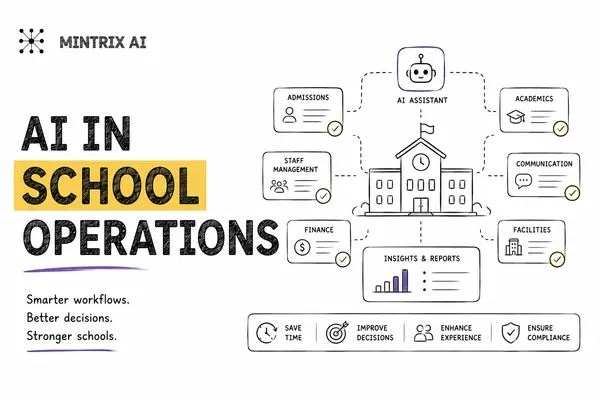
Mintrix is an AI-native School Operating System. It was built to cut the repeat work that keeps teachers up at night.
Attendance flows in on its own. Parent messages get first drafts. Lesson planning gets smart help. Reports come together in minutes, not weekends. Timetables adjust themselves when a teacher is absent.
Mintrix doesn’t replace the teacher. It clears the desk so the teacher can teach.
Conclusion
Teachers joined this profession to spark curiosity, not to file forms. When schools take repetitive tasks off their plate, everyone wins. Students get more attention. Teachers get their evenings back. Schools see stronger results.
The tools now exist to make this real. The only question is who will use them well.